
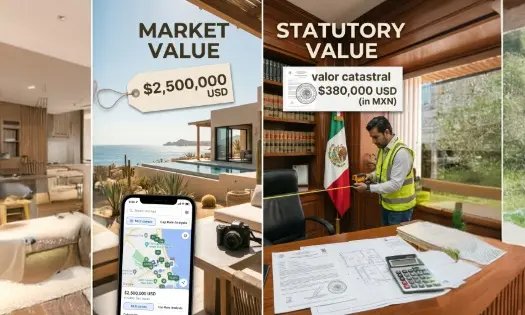
Buying or pricing real estate in Baja California Sur exposes you to a costly blind spot if you rely on North American valuation habits. A single oceanfront estate can carry three completely different price tags—and the highest number dictates your closing tax bill.
- Reconcile conflicting data: Separate BCS MLS closed comps, off-MLS developer silos, and peso-skewed federal housing indices.
- Master commercial pricing: Adjust USD comps for micro-markets, Q1/Q3 seasonal spreads, net vacation rental cap rates, and replacement cost floors.
- Avoid closing-table tax traps: Navigate Los Cabos's "Highest-of-Three" ISABI rule before signing a promissory contract.
- Protect seller net proceeds: Deploy a retroactive avalúo referido to substantiate renovations and cut Mexican capital gains tax (ISR).
An oceanfront villa above the Sea of Cortez lists for $2.5 million USD on the Baja California Sur Multiple Listing Service (BCS MLS). Down the coast, the seller’s annual municipal property tax bill (predial) values that exact estate at $380,000 USD in Mexican Pesos. Two weeks before closing, a court-certified architect measures the travertine terrace and issues a third figure that adds $14,000 USD to the buyer's closing tax bill.
Cross-border real estate in Los Cabos splits into two separate valuation systems. Unlike Phoenix, San Diego, or Vancouver—where one public deed registry aligns market prices with tax assessments—Cabo property valuation models divide commercial pricing from Mexican tax law.
Cabo property valuation models span two parallel systems: commercial market models—which determine fair market value in USD using BCS MLS comps, short-term rental net cap rates, and luxury replacement costs—and Mexican statutory models (avalúo comercial pericial and valor catastral), which set legal tax bases in MXN for Notarios Públicos and SAT.
Why Cabo Property Valuation Models Break North American Rules
Automated Valuation Models (AVMs) fail in Cabo San Lucas and San José del Cabo. Mexico does not publish closed deed prices in a public county database. Without public deed disclosure, pricing intelligence fractures across three incompatible sources.
Reconciling BCS MLS Comps, Off-MLS Developer Silos & the SHF Index
A reliable Los Cabos real estate appraisal or pricing analysis weighs three datasets that track entirely different segments of the market:
- BCS MLS Closed Resales: The BCS MLS records brokered resales across Cabo San Lucas, the Tourist Corridor, San José del Cabo, the Pacific Side, and the East Cape. After reaching $1.59 billion USD in volume in 2025 (1,834 sales averaging $854,409 USD), 2026 transactions shifted toward disciplined price discovery. Across the 12 months ending October 2026, BCS MLS logged 982 closed sales at a median price of $420,000 USD and a blended median of $265 USD per square foot. However, some brokerage reports index properties by Under Contract Date rather than final Closed Date, concealing negotiated price cuts until deed registration.
- Off-MLS Developer & Branded Silos: Roughly $400+ million USD in annual Los Cabos sales close completely off-MLS. Ultra-luxury branded residences, fractional clubs, and master-planned presales trade through private galleries rather than public broker feeds. Relying solely on MLS comps misses top-tier pricing ceilings set by resort-anchored luxury villa communities.
- The Federal SHF Housing Index: Mexico's Sociedad Hipotecaria Federal (SHF) reported a +7.3% year-over-year price gain in Baja California Sur in Q2 2026 (+96% over five years). That index tracks only homes financed with Mexican peso mortgages—skewing toward domestic workforce housing rather than the 80%+ cash and cross-border USD deals that drive coastal values.
Solving the Dual-Currency Paradox (USD Listings vs. MXN Taxes)
Brokers quote and negotiate Los Cabos properties in U.S. Dollars, yet every Mexican legal instrument runs strictly in Mexican Pesos (MXN).
At closing, the Notario Público converts the USD purchase price into pesos using the official exchange rate published in the Diario Oficial de la Federación (DOF) the day before signing. Currency swings alter tax math immediately. Between early September 2026 and mid-November 2026, the peso moved from under 17.00 MXN/USD to roughly 18.55–18.60 MXN/USD. Buying when the peso sits strong and selling when it weakens creates "phantom" peso gains on paper—inflating the seller's capital gains tax (ISR) even if the villa sells for the exact same USD figure.
Commercial Market Models: How Buyers & Investors Price Cabo Real Estate
When setting an asking price, drafting an offer, or underwriting an acquisition, analysts apply three commercial methods calibrated to Baja California Sur micro-markets.
1. Sales Comparison Approach: Micro-Markets, Views & Seasonal Spreads
Calculating Cabo San Lucas price per square foot demands strict geographic segmentation. A market-wide median of $265/sq. ft. obscures steep neighborhood spreads:
- Micro-Market Multipliers: Turnkey marina residences in Cabo San Lucas command $600 to $950+ per square foot. Prime oceanfront estates along the Tourist Corridor and San José del Cabo lift Q1 2026 single-family averages to $1.17 million USD overall and $3.54 million USD in the $1M+ luxury tier.
- Gate & Amenity Buffers: Master-planned golf communities insulate resale values during buyer-favored cycles. Sales data from July 2025 through October 2026 shows Palmilla holding a 95.4% sale-to-list price ratio (SLPR) and Querencia and Quivira retaining 93.9%, outperforming non-golf hillside communities like Pedregal (90.0%).
- Qualitative Adjustment Variables: Local appraisers weight four non-square-footage factors heavily:
- View Corridor Protection: Unobstructed Sea of Cortez sunrise views or Land's End arch sightlines earn 15%–35% premiums over partial corridor views exposed to future vertical builds.
- Water & Power Independence: Desalination plant access, oversized cisterns (aljibes), and solar-battery arrays boost resale demand across arid coastal zones.
- Club Equity Transferability: Conveying an active golf or beach club membership—with locked initiation fees—swings net property value by six figures.
- Seasonal Timing: Regression data across 5,525 MLS sales (2023 through October 2026) shows high-season Q1 closings (January–March) average 95.7% SLPR, while summer Q3 closings (July–September) drop to 92.2% SLPR. Analysts adjust comps for this 3.5% seasonal spread ($35,000 per $1M).
Broker CMA vs. Certified Appraisal: When weighing a Los Cabos CMA vs certified appraisal, treat an agent's Comparative Market Analysis strictly as an informal pricing estimate. A CMA carries zero legal standing, imposes no statutory liability, and satisfies neither a Notario Público nor a Mexican bank.
2. Income Capitalization Approach: Stress-Testing Cabo STR Net Cap Rates
Vacation rental investors anchor property value to Net Operating Income (NOI) divided by a target capitalization rate:
PropertyValue=NetOperatingIncome(NOI)TargetCapRate
Applying cap rates to gross AirDNA projections inflates property values artificially. A disciplined Cabo vacation rental cap rate valuation strips out five coastal operating expenses before calculating net vacation rental ROI in Cabo San Lucas:
- Realistic Occupancy Baselines: Peak winter months top 90% occupancy, yet full-year regional hotel and STR benchmarks average 70% due to September–October low-season lulls.
- HOA & Master Association Dues: Resort communities with 24/7 security, beach clubs, and desalination plants charge substantial monthly USD assessments.
- Property Management Splits: Full-service vacation rental managers in Los Cabos capture 20% to 30% of gross booking revenue.
- Annual Fideicomiso Trust Fees: Foreign owners holding coastal title through a Mexican bank trust (fideicomiso) pay roughly $500 to $1,000+ USD plus IVA in annual trustee fees.
- Mexican Tax Withholdings: Booking platforms (Airbnb/VRBO) withhold 16% IVA and progressive ISR income tax (4%–10% with a Mexican tax ID/RFC, or 20%+ without one), plus Baja California Sur's state lodging tax.
After deducting these costs, turnkey Cabo vacation rentals typically underwrite at 5.5% to 7.5% net cap rates. Beachfront trophy villas compress lower due to long-term land appreciation.
3. Cost Approach: How Replacement Floors Anchor Luxury Values
In upper-tier markets where $1M+ homes averaged 310 Days on Market and 44.6 months of inventory in Q1 2026, buyers often expect steep discounts. Sellers rarely concede them because the Cost Approach sets a hard price floor:
PropertyValue=LandValue+(ReplacementCostNew-Depreciation)
Scarce coastal land, hurricane-rated reinforced concrete engineering, imported stone and millwork, and specialized coastal labor push replacement costs higher each year. When building an equivalent villa costs more per square foot than buying an existing resale—and demands 24 to 36 months of permitting—replacement cost prevents deep luxury price drops.
Mexican Statutory Valuation Models: How Notaries & SAT Tax Your Closing
Once a seller accepts an offer, commercial pricing yields to Mexican statutory rules. At the closing table, valuation determines which official number the government uses to tax the transfer.
Avoiding the "Highest-of-Three" ISABI Acquisition Tax Trap
Under Article 37 of the Ley de Hacienda para el Municipio de Los Cabos, the municipal Real Estate Acquisition Tax (ISABI)—set at 3.0% since 2025—never defaults automatically to your contract price. The Notario Público assesses ISABI on whichever of three values is highest:
- The Contract Price: The agreed purchase price written in the sales contract.
- The Valor Catastral: The fiscal value recorded by the municipal cadastre (Catastro).
- The Avalúo Comercial Pericial: The certified commercial appraisal signed by an authorized appraiser.
For residential dwellings, Los Cabos deducts five times the annual UMA (Unidad de Medida y Actualización—roughly $213,973 MXN in 2026) from the taxable base before applying the 3% ISABI rate. This yields an effective acquisition tax rate of 2.87% to 2.98% within your overall Los Cabos buyer closing costs.
How the Trap Works: Suppose you buy an off-market San José del Cabo condo for $500,000 USD ($9.3M MXN), well below market value. During closing, the certified appraiser values the unit at $620,000 USD ($11.53M MXN). You pay the seller $500,000 USD—yet the Notario Público calculates your 3% ISABI tax and registration fees on $620,000 USD, adding roughly $3,600 USD in unexpected closing taxes.
Inside the Local Valuation Supply Chain (Catastro, Perito & Notario)
Completing an avalúo comercial Los Cabos coordinates four local institutions in strict sequence:
- Municipal Catastro (Valor Catastral): Comparing cadastral value vs market value Mexico real estate exposes a wide gap. The Dirección Municipal de Catastro calculates fiscal value using standardized land-zone tables and basic depreciation formulas—usually landing 40% to 75% below market value. However, periodic municipal reassessments can lift a property's valor catastral close to market price, making the seller's predial bill the first document every buyer must inspect.
- Certified Peritos Valuadores: Real estate agents cannot issue legal appraisals in Mexico. Only a licensed perito valuador—a state-authorized architect or civil engineer holding postgraduate valuation credentials—signs a statutory appraisal. Residential fees typically run $2,100 to $8,000+ MXN, scaling higher for custom luxury estates.
- The Notario Público & Panel Rules: Notaries and fideicomiso banks assign appraisers from vetted institutional panels. A certified avalúo comercial expires 90 calendar days after issuance. If permitting or title delays push closing past day 90, the appraiser must re-issue the report before deed signing (escrituración).
- Square-Meter Manifest Audits: During the site visit, the perito measures exact built square meters. If a seller added an unpermitted rooftop palapa, casita, or terrace enclosure omitted from the municipal cadastral manifest (manifestación de construcción), the appraisal flags the discrepancy—halting closing until architectural plans are regularized.
Cutting Seller Capital Gains (ISR) with an Avalúo Referido
Sellers deploy a specialized valuation instrument—the avalúo referido (retroactive appraisal)—to lower Mexican capital gains tax (ISR) legally.
Non-resident sellers choose between paying 25% ISR on gross sale proceeds with zero deductions, or 35% ISR on net profit after deducting original purchase costs, notary fees, broker commissions, and capital improvements. Under Servicio de Administración Tributaria (SAT) rules, renovation deductions qualify only when backed by official Mexican tax invoices (facturas with CFDI XML files).
When a seller remodeled a Cabo property years ago without collecting facturas, a licensed perito valuador executes an avalúo referido. By auditing materials, architectural age, and historical construction indices, the perito certifies what those upgrades cost when built—restoring deductible cost basis and slashing net ISR taxes.
Comparison Matrix: Choosing the Right Cabo Property Valuation Model
Valuation Model | Issuing Authority | Legal Standing | Currency & Base | Typical Cost & Turnaround | Validity Window | Primary Use Case |
Broker CMA (Comparative Market Analysis) | Licensed AMPI / BCS MLS Agent | None (informal pricing estimate) | USD (active/sold MLS comps) | Free via broker (24–48 hrs) | Dynamic (30–60 days) | Setting listing prices, drafting offers, and benchmarking comps |
Valor Catastral (Cadastral Value) | Municipal Catastro of Los Cabos | Binding fiscal baseline (on predial bill) | MXN (municipal land + build tables) | Public record on predial receipt | Annual (until reassessment) | Calculating annual predial tax and checking the ISABI floor |
Avalúo Comercial Pericial | Certified Perito Valuador (Notary Panel) | Full legal & fiscal validity (Notary, SAT) | MXN (market, cost & income blend) | 2,100–8,000+ MXN (3–7 business days) | 90 calendar days | Deed closing (escrituración), 3% ISABI tax base, and fideicomiso setup |
Avalúo Referido (Retroactive Appraisal) | Certified Perito Valuador | Binding SAT deduction instrument | MXN (historical construction value) | 4,000–12,000+ MXN (5–10 business days) | Tied to historical upgrade date | Substantiating un-invoiced renovations to lower seller ISR tax |
5-Step Valuation Due Diligence Checklist Before Closing
Execute these five checks before releasing earnest money into escrow:
- Verify the Seller’s Predial Receipt Pre-Offer: Request the current municipal property tax bill before signing a Promissory Purchase Agreement (Contrato de Promesa de Compraventa). Check whether the valor catastral already exceeds your offer price.
- Match Built Square Meters to Title: Compare square footage on the BCS MLS sheet against the escritura and municipal cadastral manifest. Negotiate regularization costs for unpermitted additions into the contract before the perito inspects the home.
- Request a Written Notario Tax Estimate: Ask the closing Notario Público for an itemized closing quote identifying which of the three statutory values sets your 3% ISABI tax base—and verify that the 5-UMA residential deduction is included.
- Schedule the Avalúo Inside the 90-Day Window: Confirm the notary's approved perito valuador early, and time the site inspection so the signed appraisal stays valid through your scheduled closing date.
- Stress-Test USD/MXN Exchange Swings: Model closing costs and future resale ISR taxes across a ±10% peso exchange range so DOF rate shifts on signing day never disrupt your cash reserves.
Frequently Asked Questions
How is property value determined in Los Cabos for tax purposes?
Under Baja California Sur municipal tax law, the 3% ISABI acquisition tax applies to the highest of three values: the agreed contract price, the municipal valor catastral, or a certified avalúo comercial pericial. The Notario Público never averages these figures; whichever number is highest automatically becomes the legal tax base.
Why is the cadastral value (valor catastral) lower than the purchase price in Cabo?
The Dirección Municipal de Catastro calculates valor catastral using conservative municipal land-zone schedules and standardized depreciation tables rather than live luxury market demand. While this keeps annual predial property taxes low, periodic municipal reassessments can raise cadastral figures substantially on renovated or oceanfront homes.
What is the difference between a CMA and a certified avalúo in Mexico?
A Comparative Market Analysis (CMA) is an informal pricing estimate built by a real estate agent from recent MLS sales to guide offer negotiations. A certified avalúo comercial pericial is a legally binding appraisal signed by a licensed perito valuador (an accredited architect or civil engineer) required for deed registration, bank trusts, and SAT tax filings.
How long is a property appraisal valid in Los Cabos?
A certified avalúo comercial in Los Cabos remains valid for 90 calendar days from its issuance date. If closing delays push signing past day 90 due to fideicomiso permits or title curative work, the perito valuador must re-certify the appraisal before the Notario Público can formalize the deed.
Next Steps: Audit Both Sides of Your Cabo Property Numbers
Smart Los Cabos real estate decisions reconcile both valuation frameworks before contract signing—pairing hyper-local BCS MLS and rental-yield analysis with early catastro and notario verification.
- Buying or Pricing a Los Cabos Property? Request a Dual-Lens Valuation Audit before signing a promissory contract: pair a micro-market BCS MLS comp review (adjusted for Q1/Q3 seasonality and community retention) with a pre-offer predial and 3% ISABI tax-base check so you know both your fair market value and your exact closing-table tax bill.
- Selling a Renovated Cabo Villa or Condo? Consult a certified Baja California Sur perito valuador and closing Notario Público at least 60 days before listing to see whether an avalúo referido can substantiate past upgrades and reduce your ISR capital gains tax.