
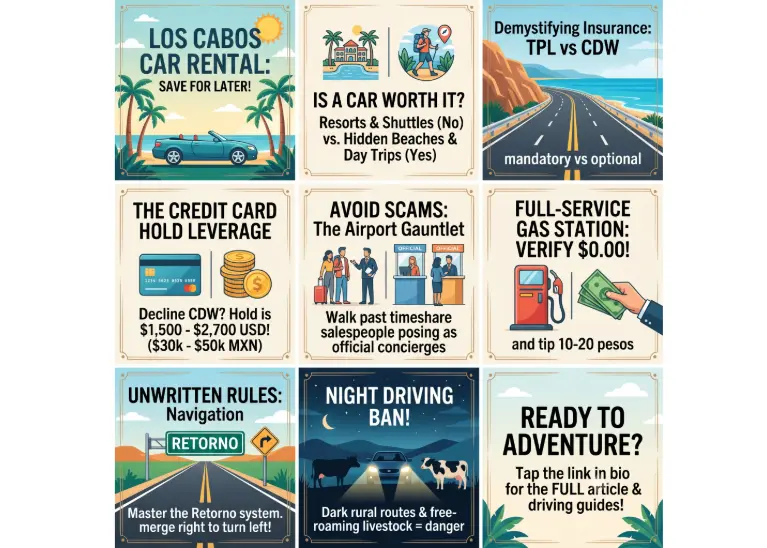
You sit at your departure gate, scrolling through a travel booking engine, and find an absolute steal: an economy car waiting for you at the San José del Cabo International Airport (SJD) for a jaw-dropping $5.00 USD per day. It feels like an incredible win. You book it instantly, already visualizing yourself cruising past the sparkling Sea of Cortez with the desert breeze in your face.
Then you land. You clear customs, navigate the chaotic arrivals hall, and finally reach the rental car desk. The agent pulls up your voucher, types on a keyboard for an agonizing minute, and looks up with a polite smile.
"Excellent choice, señor. Your base rate is indeed $35 for the week. However, with the mandatory Mexican auto insurance, environmental fees, and local airport surcharges, your actual total is $412.50. We will also need to place a $2,500 authorization hold on your credit card."
Just like that, your carefully planned vacation budget takes a massive hit before you even exit the terminal.
This scenario plays out hundreds of times every day in Los Cabos. The internet is flooded with vitriolic one-star reviews from furious travelers claiming they were "scammed" by local rental agencies. But here is the reality from a travel insider: it isn't a scam—it is simply a complete lack of digital price transparency combined with a widespread misunderstanding of Mexican federal law.
If you want to unlock the absolute freedom of exploring the Baja Peninsula on your own terms without getting blindsided, you need a realistic, street-smart strategy. This comprehensive guide breaks down the true mechanics of renting a car in Los Cabos, clarifies the credit card insurance debate, and shares the unwritten rules of navigating Baja's highways safely.
The 3-Question Travel Style Quiz: Do You Actually Need a Car?
Before diving into booking mechanics, let’s determine if getting behind the wheel makes financial sense for your specific travel style. Many vacationers default to a rental without calculating their actual itinerary needs. Ask yourself these three questions:
- Are you staying exclusively at an all-inclusive resort? If your primary goal is to lounge poolside in the Tourist Corridor, eat at the resort buffet, and leave the property exactly once for a sunset catamaran tour in Cabo San Lucas, do not rent a car. You will pay a premium to let a vehicle sit in a valet lot, and many luxury resorts tack on daily parking fees. For seamless airport arrivals without a car, check out SJD Taxi for reliable shared and private airport transfers.
- What is your budget for taxi and shuttle pricing? Taxis in Los Cabos are notoriously expensive. A standard, 15-minute ride from a resort in the Tourist Corridor to downtown Cabo San Lucas can easily run $35 to $45 USD each way. If you plan to dine out at local restaurants every night, those taxi fares accumulate rapidly, easily crossing the $500 mark for a week-long stay. Uber is available but can face strict geo-fencing restrictions around certain resort zones.
- Do you want to explore the real Baja? If your itinerary includes a day trip to the magical surf town of Todos Santos, a drive up to San José del Cabo’s historic Art District for the Thursday Night Art Walk, snorkeling at Cabo Pulmo Marine National Park, or searching for uncrowded beaches along the East Cape, a rental car is an absolute necessity.
Independent exploration breaks even with local transportation costs almost instantly. If you value spontaneity, a rental car pays for itself in sheer freedom. To look at trusted independent car bookings, you can review aggregate pricing options on Discover Cars to compare global and local agencies upfront.
Demystifying Cabo Car Rental Insurance: TPL vs. CDW
The absolute biggest point of friction at any Mexican car rental desk revolves around insurance. Let’s strip away the high-pressure sales pitch and look at what is legally required versus what you can safely decline.
1. Mandatory TPL (Third-Party Liability)
By Mexican Federal Law, every driver must carry Third-Party Liability insurance (known locally as Daños a Terceros) issued by a licensed Mexican underwriting company. This is entirely non-negotiable. Mexico's consumer watchdogs, such as PROFECO, require that agencies clearly separate these legal mandates from baseline vehicle quotes, though third-party booking sites still frequently obfuscate them.
Critical Fact: Your domestic personal auto insurance policy carries absolutely zero legal weight in Mexico. Furthermore, no standard personal credit card covers third-party liability.
TPL covers the damage you cause to other people, their vehicles, and public property if you are at fault in an accident. Because third-party booking engines often omit this mandatory fee from their initial online search results to look hyper-competitive, you are forced to purchase it at the counter. Legitimate TPL generally adds $10 to $25 USD per day to your rental cost, regardless of what your initial online voucher states.
2. Optional CDW (Collision Damage Waiver)
Collision Damage Waiver covers the physical rental vehicle itself if it is damaged, stolen, or structurally compromised. This is where you can save a significant amount of money using a premium credit card.
Many top-tier travel credit cards (such as the Chase Sapphire Preferred, Capital One Venture X, or American Express Premium Car Rental Protection) offer Primary Car Rental Insurance as a built-in benefit. This benefit covers CDW internationally, including in Mexico.
If you plan to leverage your credit card's primary CDW coverage to decline the rental agency’s expensive in-house collision packages, you must prepare for the counter protocol:
- Print the official benefit statement: Log into your credit card rewards portal and download the formal letter detailing your "Auto Rental Collision Damage Waiver" coverage. Ensure it explicitly states that coverage is valid internationally and includes Mexico. Bring a physical, printed copy to the counter.
- Prepare for the Authorization Hold: When you decline the rental agency's collision insurance, the local franchise assumes all immediate financial risk. To mitigate this, they will place a massive authorization hold on your credit card.
Depending on the agency, this credit card freeze ranges from $1,500 to $2,700 USD ($30,000 to $50,000 MXN). If your credit limit cannot handle a temporary multi-thousand-dollar hold on day one, you will be denied the vehicle unless you agree to purchase their full, in-house coverage package.
Visualizing Your Insurance and Hold Choices
To help you calculate your real-world out-of-pocket costs and avoid unexpected credit card rejections at the airport, utilize this interactive budget estimator to see how your insurance choices impact your wallet:
How to Avoid the Top Car Rental Scams in Los Cabos
Navigating the local car rental ecosystem requires a high degree of situational awareness. If you know what to expect, you can effortlessly deflect high-pressure sales tactics.
1. Surviving the Airport "Gauntlet"
When you arrive at SJD International Airport, you will collect your bags and pass through a sliding door into a secondary room before reaching the actual outdoor exit. This area is affectionately known by locals as "The Gauntlet" or "The Shark Tank."
The room is lined with professional-looking booths featuring logos for major car rental brands, timeshare resorts, and local excursions. People holding clipboards will approach you aggressively, asking to check your reservation or hand you a "mandatory" shuttle ticket.
Do not stop walking. These individuals are almost exclusively timeshare presentation salespeople. They will look at your reservation, tell you it's invalid, or claim the office is closed, all to lure you to an off-site property for a morning sales pitch in exchange for a discounted rental. Keep your head down, say a polite but firm "No, gracias," and walk completely outside to the designated shuttle pickup area where the actual, uniformed vans for your rental company reside. For real-life travel testimonies regarding this exact airport transition, check out public forums like the Tripadvisor Los Cabos Forum, where hundreds of travelers share recent counter experiences.
2. The Smartphone Pre-Inspection Protocol
Once you are at the actual rental lot and a vehicle is assigned to you, do not let the lot attendant rush you through the inspection process. If you fail to document pre-existing damage, you will be held financially responsible when you return the keys.
Take your smartphone, open the video app, set it to a high resolution, and walk slowly around the entire perimeter of the car. Pay specific attention to:
- The lower edges of the front and rear bumpers (which frequently scrape against local speed bumps).
- Small chips, cracks, or pitting on the front windshield.
- The condition of the tires and wheel rims (curb rash is highly penalized).
- The spare tire, jack, and lug wrench in the trunk (ensure they are physically present).
Make sure the lot agent checks off every single blemish on their official paper or digital matrix before you sign your name and drive out of the gate. For an extensive overview of general travel safety metrics and local operational guidelines in Mexico, check out the U.S. Department of State Mexico Travel Advisory pages.
3. The Full-Service Gas Station Check
Gas stations across Baja California Sur are entirely full-service. You do not pump your own fuel. While the vast majority of station attendants are honest, a few well-known regional tricks target distracted tourists.
When you pull up to the pump, step completely out of your vehicle. Look directly at the digital screen on the pump and visually confirm that the attendant resets the meter to $0.00 before they place the nozzle into your gas tank. If you stay inside the car, an unscrupulous attendant might pick up right where the last driver left off, charging you for fuel you never received.
Pro Tip: When paying cash, hand the bills to the attendant one by one, stating the denomination out loud (e.g., "Quinientos, setecientos pesos"). This prevents the classic "switcheroo" trick, where an attendant quickly swaps your 500-peso bill for a 50-peso bill while your back is turned and claims you underpaid. It is customary and highly appreciated to tip the pump attendant 10 to 20 pesos for cleaning your windshield and checking your fluids.
Mastering the Unwritten Rules of Driving the Transpeninsular Highway
Driving in Los Cabos is an incredible experience, but the regional road infrastructure requires an adaptation of your driving habits. Mexico's Highway 1, the Transpeninsular Highway, connects San José del Cabo and Cabo San Lucas, and it operates under its own distinct set of unwritten rules.
1. Navigating the "Retorno" System
The Transpeninsular Highway is a high-speed corridor with an unusual safety design for making turns. If you want to make a left turn to get to a beach, hotel, or shopping center on the opposite side of the highway, you cannot simply turn left from the fast lane. Doing so will almost certainly result in a severe rear-end collision.
Instead, you must look for signage indicating a Retorno (U-Turn). As you approach, you will merge completely to the right side of the highway into a designated, looping collector lane. You will stop, wait for a clear break in highway traffic from both directions, and then cross all lanes of traffic to loop back around. It requires patience and an alert eye.
2. The Strict Night-Driving Ban
If there is one rule you must never violate while driving a rental car in Baja, it is this: never drive outside major city centers after the sun goes down.
While the main highway between Cabo San Lucas and San José del Cabo is well-traveled and partially lit, rural routes leading to Todos Santos, La Paz, or Cabo Pulmo become pitch black. These corridors cut directly through open ranch lands. Free-roaming livestock (ganado), including massive bulls, cows, and horses, regularly wander onto the asphalt at night because the dark road surfaces retain the desert heat from the day. Striking an animal at highway speeds is catastrophic, and your rental insurance will often be voided if an accident report shows you were operating on unpaved or rural roads after dark. To map out your driving routes ahead of time and view detailed daylight conditions, consult resources like Baja Bound Auto Insurance which features comprehensive driving guides and roadside advice for the entire peninsula.
3. The Infamous Baja Topes (Speed Bumps)
In Mexico, speed control is largely enforced by structural concrete rather than hidden radar cameras. These speed bumps, known as topes, are scattered across every town, residential entrance, and highway transition zone.
Topes range from small rows of metal yellow domes to massive, axle-snapping concrete blocks built across the road. Quite often, they are completely unpainted, missing warning signs, and hidden under the shade of overhanging trees. Always watch the brake lights of local drivers ahead of you. If you see the vehicle in front of you suddenly slow to a crawl, hit your brakes immediately. Hitting a tope at 40 mph will cause severe undercarriage damage that you will have to pay for out of pocket.
Verified Local Recommendations: Choosing Your Agency
To ensure a flawless car rental experience, your choice of provider matters immensely.
Booking Direct vs. Third-Party Aggregators
Avoid using discount travel booking sites that promise impossibly low numbers without factoring in local taxes. Instead, book directly on the official website of the rental company's Mexican corporate division (e.g., Hertz Mexico, Avis Mexico) or choose highly rated local independent agencies.
Local institutions like Cactus Car Rental or reliable booking platforms like Discover Cars are highly recommended by regional travel forums because they provide "All-Inclusive" transparent pricing options right on their booking screen. When you book with them, the price you see online includes the base rate, local VAT tax, airport fees, and the legally required mandatory TPL insurance. The price you lock in online is exactly what you pay at the counter.
Required Documentation Checklist
When you arrive at the counter, make sure you have the following items physically organized:
Document | Requirement Details |
Driver's License | A valid, unexpired license from your home country. If your native license uses a non-Latin script, you must provide an International Driving Permit (IDP). For official updates on international road legalities, you can reference the Federation Internationale de l'Automobile (FIA) parameters. |
Passport | Must be valid for the entire duration of your stay in Mexico. |
Credit Card | A major credit card (Visa, Mastercard, Amex) in the exact legal name of the primary renter listed on the vehicle contract. Debit cards are rarely accepted for security holds, and cash deposits are non-existent. |
Age Restraints | The legal driving age in Mexico is 18, but nearly all commercial rental agencies require drivers to be at least 21. If you are between 21 and 24 years old, expect a mandatory "Young Driver" surcharge ranging from $10 to $25 USD per day. |
Your Complete Rental Counter Action Plan
Now that you possess the insider knowledge, let's look at a quick action plan for a seamless counter experience:
- Step 1: Complete your booking directly with a transparent agency that includes TPL upfront.
- Step 2: Ensure your chosen credit card has an available balance of at least $3,000 to absorb the temporary insurance deposit hold without freezing your spending cash.
- Step 3: Keep your head down through "The Shark Tank" room at SJD Airport and head directly outdoors to the official shuttle van area.
- Step 4: Present your printed credit card insurance benefit summary if you are declining the agency's CDW package.
- Step 5: Conduct a full, meticulous video walk-around of the vehicle before driving away from the lot.
Renting a car in Los Cabos is one of the single best decisions you can make to elevate your vacation. By understanding the legal requirements of Mexican auto laws, mapping out your insurance choices carefully, and respecting the local driving terrain, you can bypass the stress at the counter and dive straight into your Baja adventure.
Frequently Asked Questions (FAQs)
1. Can I use my US or Canadian auto insurance policy when renting a car in Los Cabos?
No. Mexican law strictly stipulates that foreign insurance policies are not legally recognized for liability purposes. Every rental vehicle must carry Third-Party Liability (TPL) insurance backed by a licensed Mexican underwriting entity.
2. Why is the credit card hold so high when I decline collision damage coverage?
When you opt to use your premium credit card's built-in Collision Damage Waiver (CDW) benefits instead of purchasing local collision insurance, the rental agency assumes immediate financial liability for the vehicle asset. To offset this exposure, they place an authorization block on your card—typically between $1,500 and $2,700 USD—which is immediately released once the car returns undamaged.
3. Is it safe to drive from Cabo San Lucas to Todos Santos or La Paz during the day?
Yes, daytime driving along Federal Highway 19 (to Todos Santos) and Highway 1 (to La Paz) is widely considered safe, well-paved, and highly scenic. The primary safety concerns stem from over-speeding, missing unexpected topes (speed bumps), or trying to navigate these unlit rural corridors at night when free-roaming livestock enter the roadway.
4. Can I use a debit card for the required security hold at the counter?
The overwhelming majority of commercial car rental brands in Los Cabos do not accept debit cards or cash for security holds. You must present a physical, personalized credit card in the primary driver's exact legal name with an open limit capable of handling the hold amount.
Ready to Lock In Your Los Cabos Travel Strategy?
Don't let hidden fees or unexpected insurance policies derail your upcoming vacation plans. Keep this guide handy for your arrival at SJD airport, and feel free to explore more of our regional guides to map out your ultimate Baja road trip itinerary.