
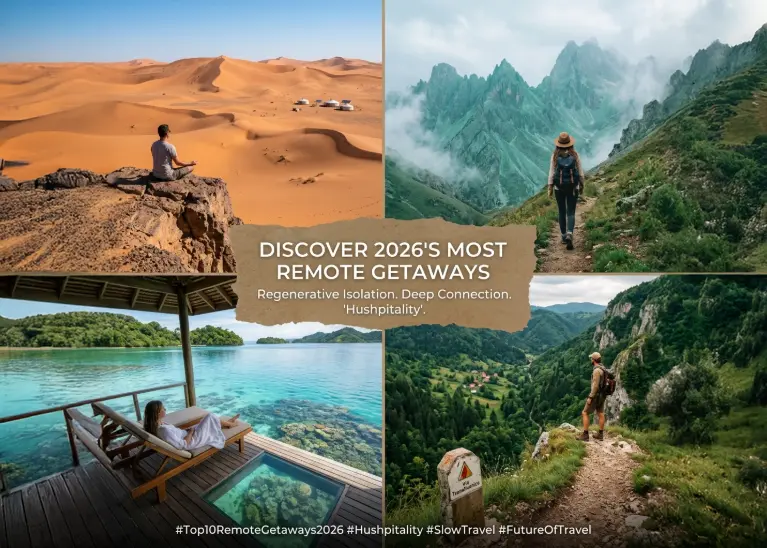
In 2026, the global travel landscape has shifted. We have outgrown the "destination dupe" and entered the era of Regenerative Isolation. Today’s travelers no longer settle for mere sustainability; they demand "Hushpitality"—a refined blend of silent luxury and deep, restorative connection to the earth.
Whether you are seeking a Coolcation to escape rising temperatures or a Micro-Expedition to test your limits, this year is about vanishing responsibly.
1. The Gobi Desert, Mongolia: Modern Nomadism
Mongolia remains the ultimate frontier. In 2026, the Gobi Desert has become the gold standard for high-end wilderness. As the "Cowboy Core" trend moves from the runway to the trail, travelers are flocking to solar-powered luxury ger camps.
- The Experience: Stay at Three Camel Lodge to enjoy five-star comfort amidst the dunes.
- The 2026 Edge: Near-zero light pollution makes this the world's premier spot for "Stargazing Wellness."
- You May Like: Check out our guide on The Best Digital Detox Gear for 2026.
2. Jaffna, Sri Lanka: The Unseen Northern Coast
While the south remains crowded, the Northern Province offers a "frozen in time" cultural immersion. 2026 travelers are choosing Jaffna for its authenticity and untouched landscapes.
- The Draw: Explore Hindu temples and colonial architecture currently undergoing community-led restoration.
- Impact: Your visit directly supports the Sri Lanka Tourism Development Authority’s regional revitalization efforts.
3. Kyrgyzstan’s Tian Shan Mountains: Alpine Solitude
Known as the "Switzerland of Central Asia," Kyrgyzstan is hosting the World Nomad Games in 2026. Despite the spotlight, the vast Tian Shan range offers total seclusion for those willing to trek.
- The Move: Sleep in traditional yurts at Altyn Arashan after a day of high-altitude trekking.
- You May Like: Learn more about Sustainable Remote Workcations in 2026.
4. The Solomon Islands: Regenerative Diving
Located in the Southwest Pacific, the Solomon Islands are pioneering reef bio-rock technology. This isn't just a dive trip; it's a chance to build the oceans of the future.
- The Highlight: Dive WWII wrecks and coral gardens with Solomons Master expeditions.
- Data: Recent reports from UNESCO highlight the critical importance of these "blue carbon" ecosystems.
5. Ikara-Flinders Ranges, Australia: Connection to "Deep Time"
South Australia’s outback offers a 500-million-year-old geological history. In 2026, travelers seek "Deep Time" connections to ground themselves in a fast-paced world.
- The Experience: Take an Indigenous-led tour with the Adnyamathanha people to learn the spiritual songs of the land.
6. The Pamir Highway, Tajikistan: The High-Altitude Road Trip
The M41 Pamir Highway is one of the highest roads on Earth. Crossing lunar-like passes at 4,000 meters, it is the ultimate journey for those who find peace in movement.
- The Tech: Thanks to Starlink, this remote route is now a viable "workcation" spot for adventurous nomads.
- You May Like: Read our review of The Top Satellite Internet Solutions for Travelers.
7. Mũi Né, Vietnam: The "Romantasy" Escape
Mũi Né is a 2026 breakout star, fitting the "Romantasy" aesthetic—landscapes so surreal they look like fantasy novels.
- Must-See: The Fairy Stream, where you wade through orange and white rock formations.
- You May Like: See our Top 10 Emerging Hotspots for 2026 list.
8. Alentejo Coast, Portugal: The Anti-Overtourism Sanctuary
While the Algarve remains packed, the Alentejo offers wild Atlantic beaches and cork forests. Strict development caps ensure this remains a "Slow Travel" haven.
- Stay: Herdade da Malhadinha Nova leads in solar-powered, organic farm-to-table luxury.
- Recommended Link: Check Rewilding Europe for more on their continental conservation projects.
9. Eastern Bhutan: High-Value, Low-Volume Privacy
Bhutan remains the most exclusive destination on Earth. By paying the Sustainable Development Fee (SDF), you fund nationwide free healthcare and forest protection.
- The Spot: The Bumthang Valley, Bhutan’s spiritual heartland.
- You May Like: Discover the True Cost of Sustainable Travel in 2026.
10. Apuseni Mountains, Romania: The Rewilding Frontier
The Via Transilvanica is Romania's answer to the Camino de Santiago. This 1,400km trail connects remote mountain villages and virgin forests.
- The Draw: Experience traditional village life that has vanished elsewhere in Europe.
- You May Like: Find the Best Hiking Boots for Long-Distance Trails.
Frequently Asked Questions (FAQ)
1. What is "Hushpitality" in 2026?
"Hushpitality" refers to the luxury of silence. It’s a travel trend focusing on destinations that offer high-end service without the noise, crowds, or digital clutter of traditional resorts.
2. Is traveling to Tajikistan or Mongolia safe for solo travelers?
Yes. Infrastructure has improved significantly. However, we recommend using World Nomads for comprehensive travel insurance and hiring verified local guides for the Pamir and Gobi regions.
3. How do I practice "Regenerative Travel"?
Choose operators that don't just "leave no trace" but actively improve the area. This includes staying at lodges that fund local schools, participating in reef restoration, or hiking trails that support rural mountain economies.
4. How can I stay connected in these remote spots?
Most luxury remote camps in 2026 utilize satellite-based internet. However, many travelers choose these spots specifically for a "Digital Detox" to improve mental well-being.
Vanish into the Extraordinary
The top 10 remote getaways for 2026 prove that the greatest luxury isn't access—it's the ability to disconnect. By choosing these destinations, you aren't just taking a vacation; you are investing in the restoration of our planet and yourself.
Ready to start your journey? Sign up for our 2026 Travel Newsletter to receive monthly insights on the world’s most secluded escapes.